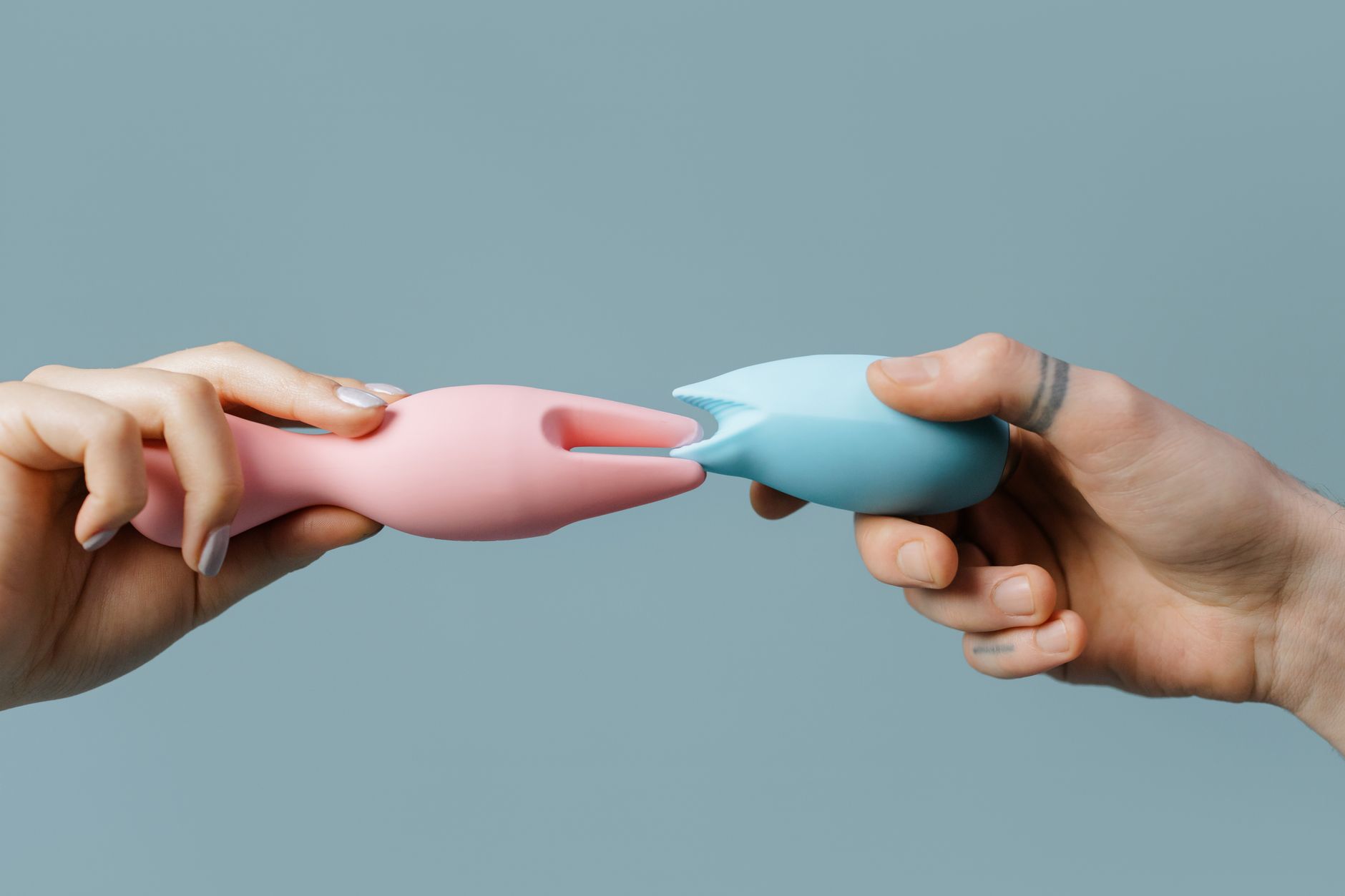
Your partner doesn't want you to use a lemon vibrator. Or maybe they say they're fine with it but get quiet when you bring one to bed. Or they make a joke that lands a little too close. The block isn't about the toy. It's about what they think the toy means: that they're not satisfying you, that you'd rather have it than them, that your pleasure somehow diminishes their role.
That belief is the wall. The toy is just what's visible from your side of it.
I've sat with hundreds of couples in this exact standoff. The conversation always starts the same way: one partner wants to introduce clitoral vibrators into shared intimacy, and the other partner hears rejection. What I've learned is that the solution isn't better marketing of The Lem Clit Toy or more sex education delivered at the moment of resistance. It's separating two entirely different conversations that people keep trying to have at once.
When your partner resists, they're usually responding to one of three fears.
Fear 1: You don't actually want them. They believe toys are a substitute, not a complement. In their mind, if you needed their touch, you wouldn't need anything else. This is wrapped up in a pretty fundamental misunderstanding about how bodies work, but it feels true to them because they've internalized a narrative about sex that says desire is monogamous. One person should be enough.
They're wrong, but they're not crazy. Our culture has sold this idea hard.
Fear 2: They'll never be able to compete. A vibrator is always going to feel different than a hand or a mouth. It's more consistent, it doesn't fatigue, it hits the same spot every time. Your partner might worry that once you've experienced that, their touch will feel insufficient. And they might be imagining a future where you'd rather be alone with a toy than present with them.
Fear 3: Introducing toys means the sex you have now is failing. If things were good, the logic goes, why would you need to change anything? The suggestion to bring in a lemon vibrator reads as criticism of what's already happening. It sounds like "what we're doing isn't working."
All three of these are about their adequacy. Not your pleasure. That's why every conversation that centers on "I need this for my orgasm" hits a nerve. You're accidentally confirming their worst fear.
Start with this: your desire for a clitoral vibrator is not about your partner's insufficiency. It's about your body's wiring. Full stop.
This is the part I need you to actually understand before you try to communicate it. Clitoral stimulation is not a lesser preference. It's not something you'd ask for if your partner was better at sex. The clitoris has 8,000 nerve endings. Direct suction stimulation, like what The Lem Clit Toy delivers, engages those nerves in a way that hands and bodies alone cannot replicate.
That's not a problem with your partner. That's anatomy.
Once you've separated those ideas in your own mind, you can say that to them: "I want to explore clitoral vibrators because my body responds to that kind of stimulation. This has nothing to do with you being enough. You are. This is about me understanding myself better."
Notice what that does. It stops positioning the toy as a solution to a problem in your partnered sex. It positions it as a tool for your own pleasure. Two different categories entirely.
After you've had the reassurance conversation, the next step is giving them a role that matters.
This is where most people get stuck. They think the solution is to leave the room or to ask their partner to feel comfortable with them using a lemon vibrator solo. Sometimes that's the move. But sometimes what actually shifts things is inviting them into the experience in a new way.
That might look like: "I'd love for you to be part of this. I want you to see what makes my body feel this way. I want you to touch me while I use it. I want to show you where I need pressure and where I don't." Suddenly the toy isn't a replacement for their hands. It's a translation tool. They get to watch your body respond. They get to participate in your pleasure even if the primary stimulation is coming from a device.
For some people, that shift changes everything. Your partner moves from feeling replaced to feeling like they're actually inside your experience in a deeper way than before.
For others, solo use feels safer and more straightforward. Both are fine. The key is asking instead of assuming, and explaining why one matters more to you if it does.
Don't bring this up during sex. Don't bring it up when you're frustrated. Don't bring it up as a solution to something that went wrong.
Have the conversation clothed, calm, not in the bedroom. Treat it like the relationship conversation it is, because it is. You're saying something important about what you want and need. That deserves attention and space.
Frame it around curiosity, not criticism. "I've been thinking about what my body needs" is different from "you're not getting me there." "I want to explore more types of stimulation" is different from "our sex life isn't working." The second version of each sentence invites defensiveness. The first invites partnership.
Give them time to sit with it. They might need a few days before they're ready to talk. That's normal. You've potentially triggered some insecurity. Let them process without pressure.
If your partner remains resistant after a genuine conversation, you have a choice to make.
You can use a lemon clitoral vibrator solo. Your solo pleasure matters and doesn't require their permission. You're an autonomous person with your own body and your own needs. Plenty of people maintain their own sexual practice independently of their partnership, and that's healthy.
But if the resistance is coming from a place of real distress or if it's connected to deeper insecurity about your relationship, that might be worth working through with a couples therapist. I've seen couples get stuck on this issue because it's actually standing in for something else. Maybe it's about feeling unseen. Maybe it's about control. Maybe it's about unresolved hurt. The toy becomes the symbol but not the source.
Once your partner is open to it, the actual mechanics are straightforward. Start slowly. Introduce the lemon vibrator as foreplay, not the main event. Let them watch you explore it first before they touch you. Many partners find that watching their partner experience pleasure is actually the hottest part. It's not competing. It's witnessing.
Use low intensity settings initially. Talk during the experience. "This feels good here," or "a little softer," or "keep doing that." Your partner learns your body in real time. They stop seeing the vibrator as a replacement and start seeing it as part of the landscape of your pleasure.
If using The Lem Clit Toy together, the suction pattern can feel intensely different than what they can create with their hands. That's the feature, not the bug. Let them experience it alongside you.
Lots of people get into their thirties, forties, fifties and realize they've never actually had a direct conversation with their partner about what pleasure feels like in their body. That's the real gap. Once you've named it, once you've given it language, once you've made it safe to talk about, toys become background noise.
Your partner might still have preferences. They might not love the idea of toys in your shared bed. That's their boundary and it's valid. But if the fundamental block was fear, and you've addressed that fear directly, often the resistance softens. People are less defensive when they feel secure.
Start with reassurance. Move to partnership. Let the toy be secondary to the conversation. That's how couples actually make this work.
Most partner resistance comes from a fear that you'd prefer the toy to them, that it means they're not satisfying you, or that toys signal the relationship is failing. These beliefs rarely connect to reality. A clitoral vibrator is a tool for your pleasure, not a judgment of their worth. Often, the threat feels real because our culture teaches people that being "enough" means fulfilling all your partner's sexual needs alone. That's an impossible standard. Addressing the underlying insecurity matters more than defending the toy.
Frame the conversation around your own body, not theirs. Say "I want to explore what my body needs" instead of "you're not getting me there." Keep it about curiosity and self-discovery, not criticism of what's already happening. Have the conversation outside the bedroom, clothed, and give them time to process without pressure. Reassure them that your desire to use a vibrator is separate from how you feel about them as a partner.
Yes, but only after you've resolved the underlying fear. Once they feel secure that the toy isn't replacing them, many partners actually enjoy being present while you use it. Some prefer to watch, some prefer to touch you while you use it, some prefer to focus on other parts of your body. The specifics matter less than the invitation and the reassurance that they're still central to the experience.
That's their boundary and it's valid. You can absolutely use clitoral vibrators solo. Your pleasure doesn't require their approval. But if the resistance is rooted in deep insecurity rather than a simple preference, that might be worth exploring with a couples therapist. Sometimes the toy becomes the symbol for a bigger gap in the relationship.
Wait. Let the initial discomfort settle. Then revisit it from a different angle. Instead of focusing on what you want, focus on what you want together. "I've been thinking about ways we could explore more," or "I'd love for us to discover new things as a couple." Sometimes reframing as shared exploration rather than solo need makes space for a different response. If they're still closed, consider whether professional support might help.
Yes. Suction stimulation engages the clitoris differently than vibration alone. It creates a seal and draws blood to the area, which many people experience as more intense and more targeted than traditional vibrators. The difference is significant enough that partners often notice it too. That's part of why introducing it can feel threatening to some people. It's not just a toy. It feels fundamentally different, which is why someone might actually prefer it for certain experiences.
The block with your partner isn't about The Lem Clit Toy. It's about vulnerability, adequacy, and what it means to be enough for someone you love. Once you've addressed that, the toy becomes what it actually is: a tool, not a threat.
Start with the conversation. Let everything else follow from there. If you're navigating this and want guidance on how to approach it, we're here to help.